
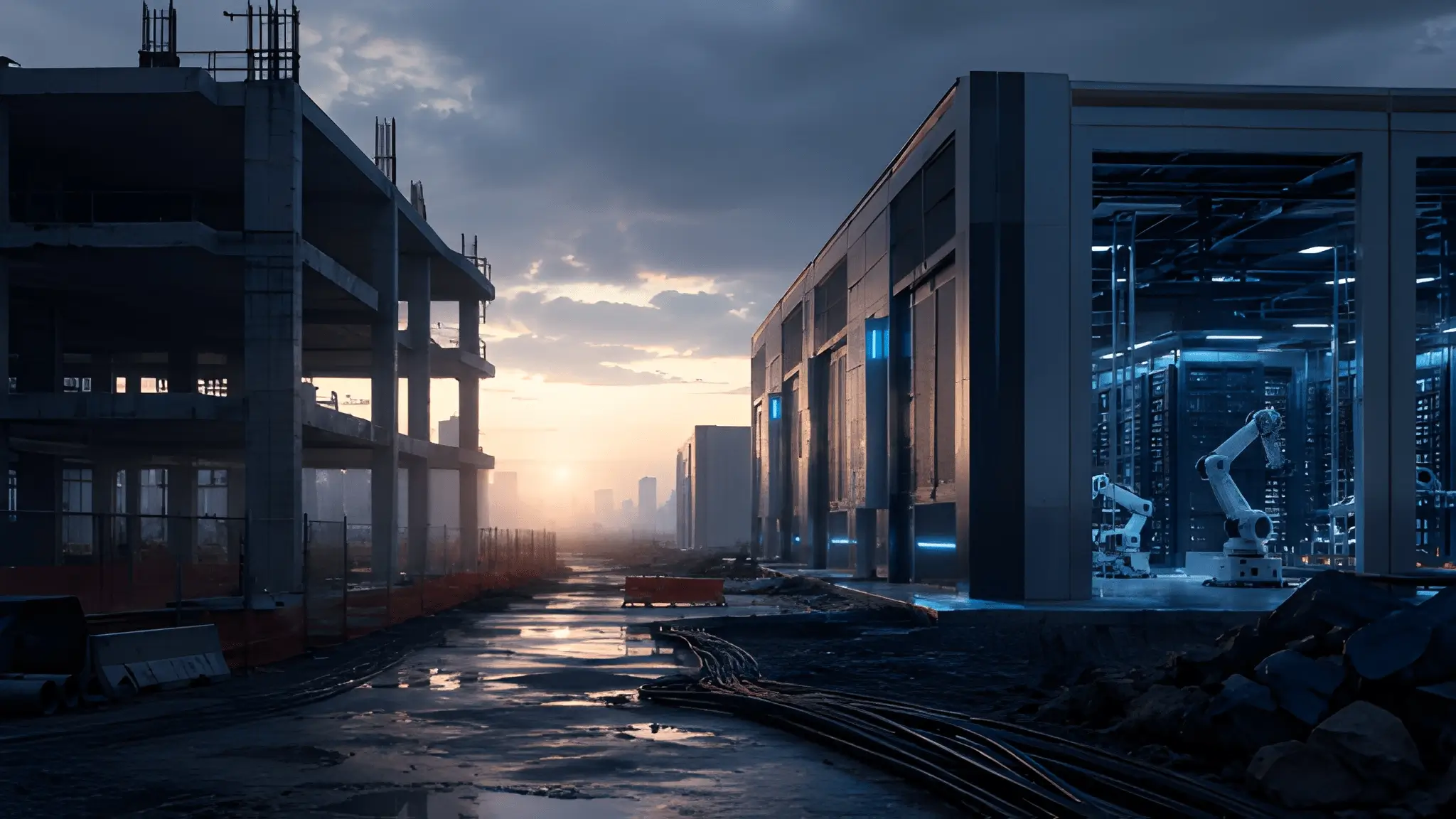
A decade ago, industrial parks competed through logistics access, tax incentives, and proximity to labor markets. Commercial campuses measured long-term value through occupancy rates, tenant diversity, and office utilization efficiency. Those assumptions now face pressure from a completely different infrastructure cycle driven by accelerated computational demand. Large-scale compute environments require electrical resilience, thermal stability, and physical expansion capabilities that many existing properties cannot support without extensive reconstruction. Buildings that once appeared future-proof suddenly reveal structural limitations when operators attempt to deploy high-density compute clusters inside conventional commercial shells. Real estate markets are beginning to recognize that digital infrastructure growth no longer follows the operational logic of traditional enterprise expansion.

Across major markets, infrastructure operators increasingly evaluate land through power delivery potential instead of aesthetic or workforce-oriented considerations. Site selection teams now prioritize transmission adjacency, water availability, cooling adaptability, and utility scalability before analyzing tenant amenities or transportation convenience. Property developers that previously specialized in office campuses or warehousing face a difficult transition because compute-intensive environments demand entirely different operational tolerances. Many existing commercial properties were not originally engineered for continuous high-density infrastructure utilization associated with modern computational deployments.. Investors have also started questioning whether conventional commercial development models can support the rapid upgrade cycles associated with accelerated computational deployments. The growing mismatch between legacy property design and infrastructure-oriented deployment requirements has created a new layer of tension across industrial real estate planning.
The AI Real Estate Crisis Nobody Saw Coming
Traditional commercial development evolved around human activity patterns rather than infrastructure density requirements associated with large-scale computational environments. Office campuses optimized for parking ratios, employee accessibility, conference capacity, and energy consumption patterns linked to daytime occupancy behavior. Industrial parks focused heavily on freight movement efficiency, warehouse scalability, and regional logistics connectivity because distribution economics dominated development priorities for decades. Modern compute environments operate under an entirely different physical logic that prioritizes uninterrupted energy delivery, thermal management, and equipment lifecycle adaptability. Existing commercial properties often struggle to accommodate the electrical redundancy and cooling infrastructure necessary for dense computational deployments without substantial structural modifications. Developers increasingly face situations where previously attractive commercial parcels may not transition efficiently into high-capacity infrastructure environments.
Large infrastructure deployments increasingly require extensive substation access, fiber route diversity, and utility coordination capabilities that many commercial zones never anticipated during original planning stages. Compute-intensive facilities also generate operational behaviors that differ significantly from office or warehouse occupancy models because infrastructure equipment functions continuously under variable load conditions. Some industrial parks lack sufficient transmission capacity to support large-scale deployments even when land availability appears attractive on paper. Retrofitting existing campuses frequently introduces construction complexity because legacy buildings were not engineered for sustained high-density power distribution or advanced liquid cooling integration. Meanwhile, developers attempting conversions often encounter delays linked to environmental review, grid interconnection approvals, and municipal infrastructure limitations that slow deployment timelines considerably. These pressures have started reshaping investment strategies as infrastructure operators shift away from traditional commercial assumptions toward long-term operational resilience models.

Why “Data Center Ready” Land Is Becoming a Misleading Label
Property marketing language increasingly promotes sites as deployment-ready even when substantial infrastructure gaps remain unresolved beneath preliminary specifications. Some industrial parcels promote fiber access or nearby substations without fully clarifying whether the surrounding utility ecosystem can sustain long-term high-density computational operations.Developers frequently classify land as suitable for infrastructure expansion despite lacking confirmed transmission scalability, water management flexibility, or permitting adaptability necessary for long-term deployment growth. Infrastructure operators now conduct deeper technical assessments because surface-level marketing claims rarely reflect the operational complexity associated with modern computational environments. Grid congestion has become a major issue in several regions where available utility capacity cannot support accelerated infrastructure expansion despite aggressive real estate positioning. As a result, deployment teams increasingly prioritize verified operational readiness instead of relying on simplified promotional terminology attached to industrial land offerings.
The phrase “ready for deployment” has also become problematic because infrastructure requirements evolve faster than traditional real estate evaluation cycles. A parcel considered operationally suitable today could require additional utility upgrades over time as infrastructure density requirements continue evolving. Developers must evaluate future cooling architectures, energy delivery flexibility, and permitting adaptability instead of focusing exclusively on immediate construction feasibility. Some regions now face extended utility connection timelines because infrastructure demand growth exceeds transmission expansion schedules already planned by local authorities. Moreover, infrastructure operators increasingly seek phased expansion potential that allows facilities to evolve alongside changing computational hardware generations without requiring complete site redevelopment. Real estate markets therefore face growing pressure to redefine infrastructure suitability through measurable operational benchmarks rather than generalized marketing classifications.
AI Infrastructure Is Quietly Rewriting Zoning Politics
Municipal governments traditionally categorized commercial properties through relatively predictable frameworks that separated office activity, industrial production, logistics operations, and utility infrastructure functions. Large computational campuses now blur those categories because they combine elements of telecommunications infrastructure, industrial energy consumption, utility-scale operations, and advanced digital services within a single deployment environment. Local authorities often struggle to determine how these facilities should fit into existing zoning structures because operational characteristics differ significantly from conventional commercial developments. Infrastructure operators require extensive electrical systems, cooling installations, and backup resiliency capabilities that resemble industrial utility infrastructure more than office real estate. Some municipalities also face political resistance from communities concerned about energy consumption, water usage, and long-term environmental impact associated with large-scale computational expansion. Consequently, zoning conversations increasingly revolve around infrastructure governance instead of traditional commercial development incentives.
Urban planners now confront difficult questions regarding how future infrastructure districts should integrate into broader regional development strategies. Existing zoning regulations rarely anticipated facilities that demand both industrial-scale utility support and advanced digital connectivity within dense metropolitan environments. Infrastructure operators seek operational certainty because prolonged permitting uncertainty can delay deployment schedules and increase project financing complexity substantially. In some regions, planning authorities have begun reassessing how industrial classifications apply to high-capacity computational environments. However, regulatory adaptation remains uneven because local governments often lack technical frameworks necessary to evaluate evolving infrastructure requirements effectively. The growing tension between infrastructure expansion goals and legacy zoning systems has started transforming municipal planning into a critical factor influencing deployment competitiveness across regional markets.
AI Expansion Is Quietly Breaking Traditional Building Lifecycles
Commercial properties historically operated around depreciation models that assumed stable utilization patterns extending across several decades of predictable tenant occupancy. Office towers, industrial campuses, and mixed-use developments often relied on renovation cycles designed to maintain long-term functionality without extensive structural transformation. Large computational environments disrupt those assumptions because infrastructure equipment evolves at a much faster pace than conventional commercial building systems. Facilities originally designed for moderate power densities may become operationally obsolete within a relatively short period when infrastructure requirements accelerate beyond original engineering thresholds. Retrofitting older commercial buildings for advanced computational deployment frequently requires significant upgrades involving electrical distribution, thermal management, structural reinforcement, and network integration systems. Those realities have forced developers to reconsider how future properties should accommodate continuous infrastructure modernization without repeated large-scale reconstruction.
Leasing models may increasingly shift toward greater operational flexibility as infrastructure operators prioritize adaptable upgrade pathways. Hardware refresh cycles now influence real estate planning decisions because computational performance expectations evolve rapidly across deployment environments. Property owners must evaluate whether existing buildings can support repeated infrastructure adaptation without excessive downtime or escalating retrofit costs. Furthermore, investors increasingly analyze operational flexibility metrics alongside conventional occupancy projections when assessing long-term commercial asset value. Some developers have started designing modular infrastructure environments capable of supporting phased equipment replacement without interrupting broader operational continuity. These changes indicate that future property economics may depend less on static physical durability and more on infrastructure adaptability across evolving deployment cycles.
Modern Campuses Were Built for Employees. AI Campuses Are Built for Machines.
Traditional commercial campuses emphasized workforce experience because tenant attraction depended heavily on collaborative environments, transportation convenience, hospitality integration, and employee-oriented amenities. Developers invested heavily in architectural aesthetics, office flexibility, and social infrastructure intended to support large concentrations of daily human activity. Computational campuses prioritize a very different operational model centered around uninterrupted machine performance, thermal efficiency, and autonomous infrastructure management systems. Staffing levels within many high-density infrastructure facilities remain relatively limited compared to conventional office environments occupying similar physical footprints. Building layouts increasingly optimize airflow management, equipment accessibility, energy resilience, and security segmentation instead of collaborative workspace functionality. These operational priorities reveal how infrastructure-focused deployments fundamentally challenge long-standing assumptions embedded within commercial campus design philosophy.
Infrastructure operators now design campuses around continuous operational resilience rather than workforce-centered utilization patterns associated with traditional enterprise real estate. Security systems focus heavily on infrastructure protection, network continuity, and operational isolation because physical disruption risks carry significant computational consequences. Cooling systems increasingly dominate site engineering decisions because thermal management directly influences deployment density, equipment reliability, and long-term operational scalability. Meanwhile, campus architecture shifts toward utility efficiency and infrastructure redundancy instead of visual branding strategies historically associated with commercial headquarters developments. Autonomous monitoring platforms, predictive maintenance systems, and remote operational management tools continue reducing dependency on large on-site staffing models. Therefore, commercial real estate strategies increasingly recognize that future infrastructure environments will prioritize machine continuity above conventional workplace optimization standards.
AI Is Turning Real Estate Into Infrastructure Strategy
Real estate markets now face a structural transition where infrastructure compatibility increasingly determines long-term asset relevance across industrial and commercial sectors. Traditional indicators such as location prestige, office occupancy demand, and conventional tenant diversification no longer provide sufficient insight into future infrastructure viability. Land valuation models increasingly incorporate utility scalability, transmission resilience, cooling adaptability, and deployment flexibility because computational expansion depends heavily on operational infrastructure foundations. Developers that continue relying on legacy commercial assumptions may struggle to compete against infrastructure-oriented strategies designed around long-term deployment resilience. At the same time, investors increasingly recognize that infrastructure readiness involves far more than physical construction capacity or available acreage within industrial corridors. The commercial property sector has entered a phase where infrastructure engineering and real estate economics operate as deeply interconnected disciplines.
Future development strategies will likely prioritize infrastructure ecosystems capable of supporting evolving computational requirements across multiple hardware and operational generations. Regional competitiveness may increasingly depend on permitting efficiency, utility modernization, and infrastructure planning coordination rather than conventional commercial development incentives alone. Developers must evaluate how future facilities can adapt to changing energy architectures, cooling technologies, and operational density requirements without repeated structural reinvention. Nevertheless, municipalities, utilities, and infrastructure operators still face significant coordination challenges as deployment demand accelerates across multiple geographic markets simultaneously. Commercial real estate increasingly incorporates infrastructure scalability as a major factor influencing long-term strategic relevance. The broader transformation underway suggests that future property value will depend increasingly on operational infrastructure flexibility rather than traditional commercial positioning metrics.











