 Skip to content
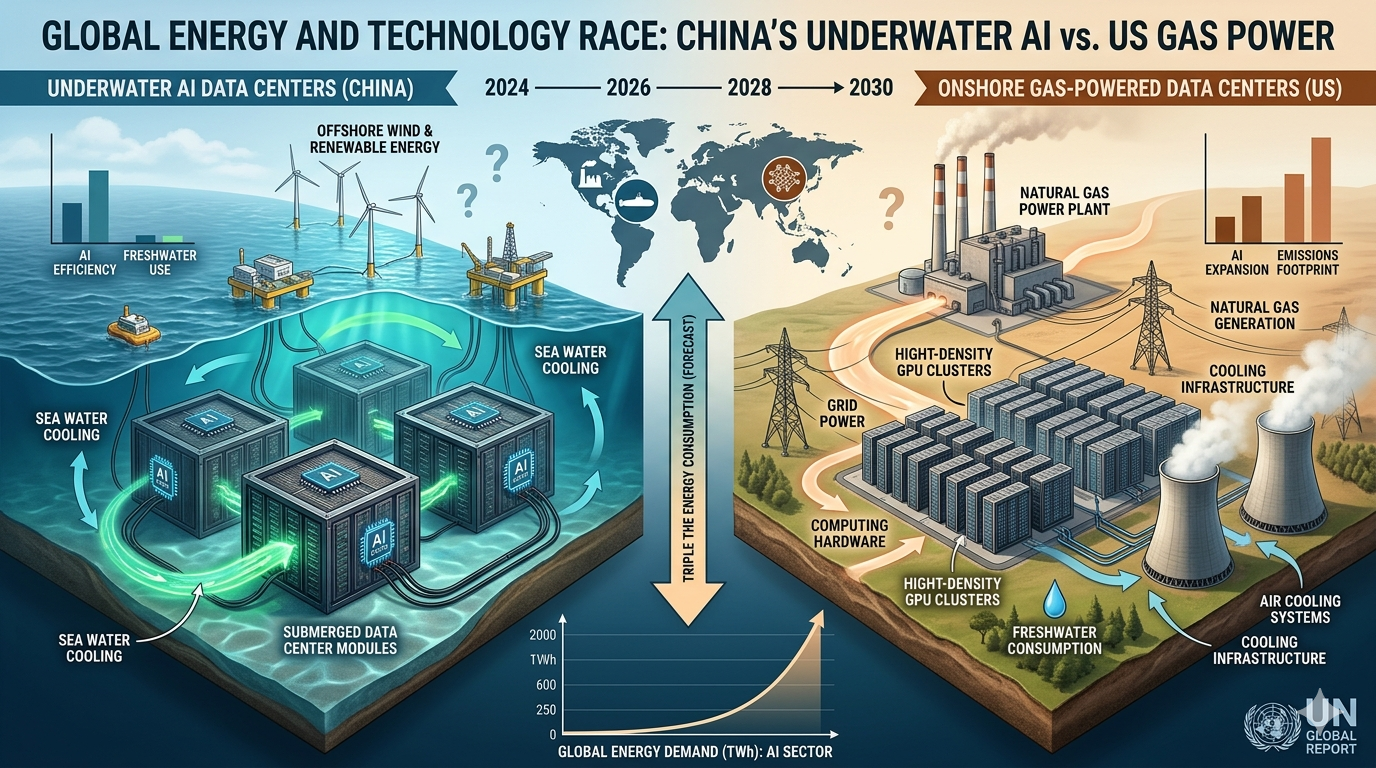
The race to build artificial intelligence infrastructure is rapidly becoming a race to secure energy, water, and land resources. As demand for AI computing accelerates, governments and technology companies are searching for ways to support increasingly power-hungry data centers. China and the United States, two of the world’s largest AI markets, are approaching the challenge through markedly different strategies. China is experimenting with offshore wind-powered underwater facilities that rely on seawater for cooling, while the United States is increasingly turning to natural gas generation to meet projected electricity demand. Both approaches seek to address the same challenge, yet they reflect different priorities regarding energy security, environmental impact, and infrastructure development. The contrast offers an early glimpse into how Sustainable AI Data Centers may evolve across different regions during the coming decade.

Why AI Infrastructure Is Creating a New Energy Challenge
Artificial intelligence workloads are changing the economics and infrastructure requirements of modern data centers. Training and operating large language models requires significantly more computing power than many traditional enterprise applications. As organizations deploy AI systems at scale, electricity demand from data centers continues to rise across major markets. Industry forecasts increasingly show AI becoming one of the fastest-growing sources of digital infrastructure energy consumption. Operators must not only secure reliable power supplies but also manage heat generated by dense clusters of GPUs and advanced processors. These pressures have elevated energy and cooling considerations from operational concerns to strategic priorities.
The challenge extends beyond electricity consumption alone because cooling systems often require substantial water resources. Conventional facilities frequently rely on freshwater to maintain operating temperatures for critical equipment. As AI infrastructure expands, concerns regarding water availability and environmental sustainability have become more prominent. Local communities and regulators increasingly examine how new projects affect regional resources. Technology companies therefore face growing pressure to balance computing growth with responsible infrastructure development. The search for Sustainable AI Data Centers has consequently become a central topic across the industry.
China’s Underwater Data Center Represents a Different Model
China recently moved forward with one of the industry’s most unconventional infrastructure experiments near Shanghai. The project, located in the Lingang Special Area, places data center infrastructure beneath the sea while integrating offshore renewable energy resources. Operators designed the facility to run on electricity generated by nearby offshore wind installations rather than relying exclusively on conventional power sources. The underwater location also allows the system to use surrounding seawater for cooling purposes. This approach reduces dependence on freshwater resources that many traditional facilities require. The project reflects broader efforts to explore alternative models for Sustainable AI Data Centers as computing demand continues to increase.

Reports indicate that the facility currently operates at approximately 2.3 megawatts and is expected to scale toward a planned capacity of 24 megawatts. The infrastructure houses thousands of servers within specialized underwater modules designed to withstand marine conditions. Engineers selected the offshore environment partly because cooler seawater can help remove heat more efficiently than conventional cooling systems. Reduced cooling requirements can improve overall energy efficiency and lower operational costs over time. The project also occupies substantially less land than a traditional facility with comparable computing capacity. These characteristics have attracted attention from industry observers evaluating new approaches to infrastructure design.
Offshore Wind and Seawater Cooling Change Infrastructure Economics
One of the most notable aspects of the Shanghai project involves its integration with renewable energy generation. Offshore wind farms provide a direct source of electricity for computing operations, creating a closer relationship between energy production and consumption. Developers argue that such arrangements could reduce dependence on distant power infrastructure while supporting decarbonization goals. Renewable integration has become increasingly important as governments seek to balance AI growth with climate commitments. Data centers often face criticism because of their rising electricity consumption. Pairing computing facilities with renewable generation offers one potential pathway toward addressing those concerns.
Cooling efficiency represents another area where the underwater model differs from conventional facilities. Industry reports suggest the project achieves a power usage effectiveness figure below 1.15, a level that compares favorably with many traditional data centers. Natural seawater circulation reduces the need for energy-intensive mechanical cooling systems. Eliminating freshwater consumption may also reduce environmental pressures in regions where water resources face growing demand. Furthermore, lower cooling energy requirements can contribute to overall operational efficiency. These factors help explain why underwater infrastructure has generated interest despite its unconventional design.
The US Is Taking a More Conventional Route
While China experiments with offshore renewable-powered infrastructure, the United States is largely pursuing a different strategy. Rising AI demand has prompted utilities, energy developers, and technology companies to focus on expanding available generation capacity. In many cases, natural gas has emerged as a preferred option because it can provide reliable power at scale within relatively short development timelines. Several proposed projects involve dedicated gas-fired facilities designed to support growing data center clusters. Supporters argue that dependable baseload generation remains essential as AI workloads continue to expand. The approach prioritizes immediate capacity needs over more experimental infrastructure concepts.
This trend reflects broader concerns about grid reliability and electricity availability across key data center markets. Operators require uninterrupted power to maintain service continuity and protect critical workloads. Renewable energy sources continue to play an important role in corporate sustainability strategies, yet intermittency challenges remain a consideration for many large-scale deployments. Natural gas facilities can provide dispatchable power capable of responding to fluctuating demand patterns. As a result, several technology companies and utilities view gas generation as a practical solution for supporting near-term AI growth. The strategy illustrates how infrastructure priorities can differ even when countries face similar computing demands.
Two Different Visions for Sustainable AI Data Centers
The divergence between the Chinese and American approaches highlights competing interpretations of infrastructure sustainability. China’s offshore project attempts to address electricity, cooling, water consumption, and land use through a single integrated design. The United States, by contrast, has largely focused on ensuring sufficient energy availability to meet rapidly increasing demand. Neither approach fully resolves every challenge associated with AI infrastructure expansion. Renewable-powered underwater facilities still face questions regarding maintenance, scalability, and long-term operational economics. Gas-supported development models must contend with concerns related to emissions and future climate objectives. Both strategies therefore involve trade-offs that policymakers and industry leaders will continue to evaluate.
Infrastructure decisions increasingly carry implications beyond technology deployment alone. Governments view AI capabilities as important economic and strategic assets, creating pressure to accelerate data center construction. Energy systems, environmental policies, and resource management practices now influence how quickly computing capacity can expand. Consequently, debates about Sustainable AI Data Centers are becoming closely linked with broader discussions about industrial policy and national competitiveness. Different regions may ultimately adopt different combinations of renewable energy, conventional generation, advanced cooling technologies, and alternative facility designs. The path chosen will likely reflect local priorities as much as technological considerations.
Can Underwater Data Centers Move Beyond Experimental Deployments?
The long-term significance of China’s underwater project will depend on whether similar facilities can scale beyond demonstration and pilot phases. Engineers must continue to address challenges related to maintenance access, equipment replacement, corrosion management, and operational reliability. Offshore environments introduce complexities that conventional land-based facilities generally avoid. Investors and operators will likely assess whether efficiency gains outweigh the costs associated with specialized deployment requirements. Commercial viability will ultimately determine whether underwater infrastructure becomes a niche solution or a broader industry trend. Early performance results will therefore receive close scrutiny from technology companies worldwide.
For now, the comparison between China and the United States illustrates how the AI boom is reshaping infrastructure planning in fundamentally different ways. Both countries recognize that future economic growth increasingly depends on access to large-scale computing resources. The question is no longer whether new data centers will be built but how they will be powered and cooled. China’s underwater facility demonstrates a willingness to experiment with alternative infrastructure models tied closely to renewable energy and resource efficiency. The American approach emphasizes rapid deployment supported by dependable energy generation capable of meeting immediate demand. Together, these contrasting strategies reveal that the future of Sustainable AI Data Centers may emerge through multiple pathways rather than a single global blueprint.










