
NVIDIA H200 shipments delayed to Q3  · BREAKING: Microsoft confirms 3GW data centre expansion in Asia-Pacific ·  AWS announces new sovereign cloud regions in India and UAE  · Arm-based servers now 24% of hyperscale deployments ·  EU AI Act enforcement enters phase two  · Global data centre investment hits $612B in 2026 ·  TSMC Arizona yields improve to 68% on 3nm process  · OpenAI valuation reaches $400B after latest funding round ·  NVIDIA H200 shipments delayed to Q3  · BREAKING: Microsoft confirms 3GW data centre expansion in Asia-Pacific ·  AWS announces new sovereign cloud regions in India and UAE  · Arm-based servers now 24% of hyperscale deployments ·  EU AI Act enforcement enters phase two  · Global data centre investment hits $612B in 2026

The End of the “Nvidia Tax” for Hyperscalers?

The phrase “Nvidia Tax” has gained traction in discussions about the economics of AI infrastructure. It refers to the structural

Share
Nvidia tax for hyperscalers

The phrase “Nvidia Tax” has gained traction in discussions about the economics of AI infrastructure. It refers to the structural cost burden borne by hyperscale cloud providers and AI service operators as a result of Nvidia’s dominant position in the accelerator market. That burden emerges from three interrelated dynamics: Nvidia’s hardware pricing power in a market with limited substitutes, deep software ecosystem lock-in centered on CUDA, and persistent supply chain constraints that slow infrastructure deployment. Together, these forces have raised the cost of scaling AI services and compressed margins for operators heavily dependent on Nvidia GPUs.

Recent developments, however, suggest that hyperscalers are beginning to recover some of that margin. The shift is most visible at the inference layer of the AI stack, where workload characteristics and economic pressures differ meaningfully from those of training. As inference becomes the primary driver of long-term AI costs, hyperscalers are adjusting their infrastructure strategies accordingly.

What the “Nvidia Tax” Really Is

The first pillar of the so-called “Nvidia Tax” is hardware pricing power. For years, Nvidia GPUs have offered the most compelling blend of performance and programmability for both training and inference. As large language models and generative AI workloads surged, demand for Nvidia accelerators exceeded supply. That imbalance strengthened Nvidia’s leverage over pricing and availability. Hyperscalers seeking rapid capacity expansion often faced premiums or were forced to commit to large orders far in advance.

The second pillar is software ecosystem lock-in. CUDA, along with Nvidia’s libraries and tooling, became the default standard for accelerated deep learning. This standardization simplified adoption but imposed high switching costs. Models, frameworks, compilers, and operational workflows grew tightly coupled to Nvidia-specific optimizations. As a result, infrastructure economics became closely tied to Nvidia’s product cadence and pricing decisions.

The third pillar involves supply chain dependency and deployment friction. Even the largest cloud providers encountered constraints in scaling infrastructure on predictable timelines. Long lead times for flagship accelerators and intermittent shortages translated into delayed deployments and lost revenue opportunities during periods of peak demand.

While Nvidia’s position in training remains robust, inference operates under a different set of constraints. That divergence is creating room for hyperscalers to pursue alternative approaches and improve margins.

Maia 200 and the Economics of Inference

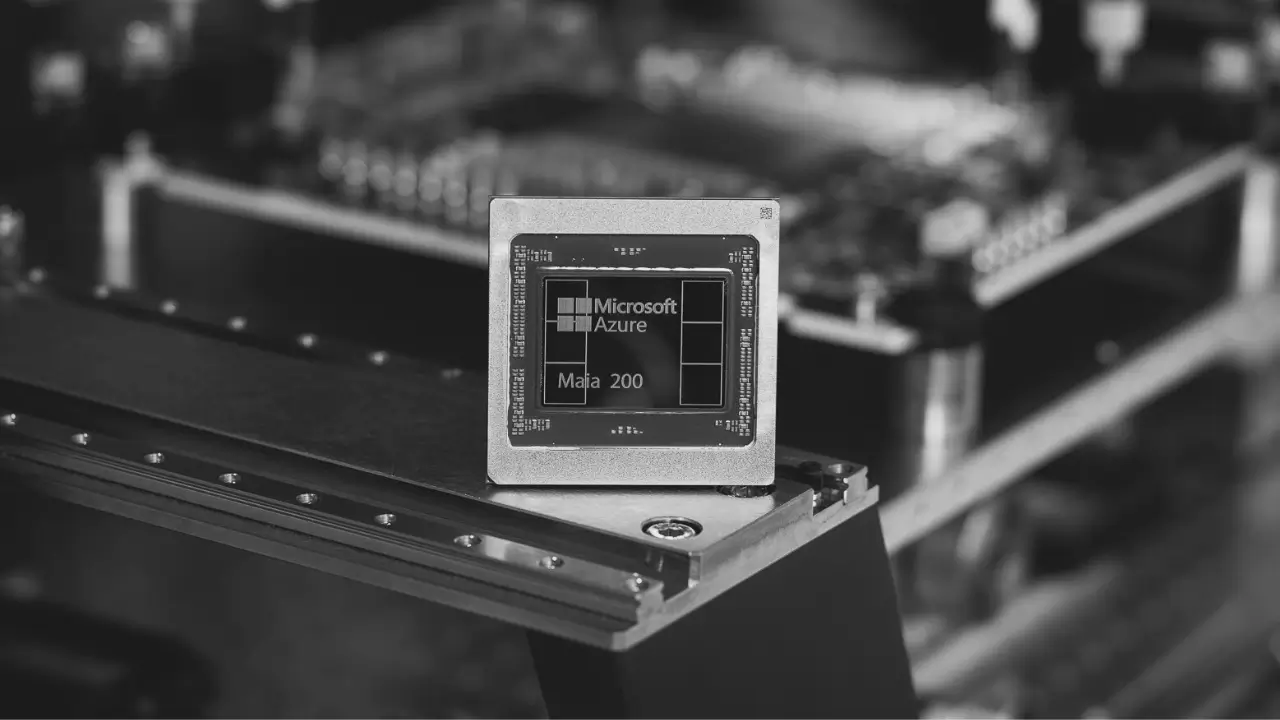
In January 2026, Microsoft introduced Maia 200, a custom AI accelerator designed specifically for inference workloads. The chip was positioned as a response to the economics of large-scale token generation rather than as a general-purpose replacement for GPUs. Built on TSMC’s 3-nanometer process, Maia 200 features low-precision tensor units, a high-bandwidth memory subsystem, and optimized data movement engines designed to sustain throughput under continuous load. Microsoft reports that Maia 200 delivers substantially higher performance per dollar on inference tasks relative to existing alternatives in its fleet.

Maia 200 should be understood as a strategic infrastructure investment, not a challenge to Nvidia’s relevance. Hyperscalers occupy a unique position that allows them to design silicon tightly integrated with their data center networks, systems software, and operational workflows. In this respect, Microsoft’s effort mirrors other vertical integration initiatives, such as Apple’s transition to its M-series processors. Apple achieved efficiency and performance gains through tight hardware–software coordination without relying as heavily on external vendors.

For Microsoft, Maia 200 serves as an economic lever. Inference workloads emphasize sustained token generation rather than peak training throughput. By tailoring silicon to that profile, Microsoft can lower the unit cost of delivering AI features embedded in products like Microsoft 365 Copilot. Deployed within Azure data centers, Maia 200 targets high-volume, production inference workloads where compute spend dominates ongoing costs.

Software enablement is central to this strategy. Microsoft’s work on runtimes such as Triton, combined with deep integration into frameworks like PyTorch, reduces friction between model development and custom hardware. Rather than attempting to displace CUDA outright, Microsoft provides a software bridge that preserves developer productivity while unlocking infrastructure efficiencies. This approach acknowledges the depth of existing ecosystem investment while still allowing meaningful diversification.

Why Inference Dominates Long-Term Economics

The emphasis on inference reflects a broader shift in AI cost structures. Long-term expenses accumulate where workloads run continuously and scale with user demand. Training remains capital intensive but episodic. Inference represents the ongoing cost of serving AI features across products and platforms.

For AI systems embedded in productivity software or consumer applications, inference workloads can exceed training workloads by orders of magnitude when measured in total compute consumed. As a result, even incremental improvements in performance per dollar at the inference layer can translate into meaningful margin expansion. Custom silicon optimized for memory bandwidth, power efficiency, and low-precision computation directly targets this opportunity.

Maia’s architectural choices reflect that reality. The goal is not maximum theoretical throughput but sustained, efficient operation at scale, where power, cooling, and utilization drive total cost of ownership.

What This Clarifies

Several realities emerge from this shift:

  • Nvidia continues to anchor frontier model training, where flexibility, programmability, and peak performance remain decisive.
  • Hyperscalers are diversifying rather than disengaging. Custom accelerators like Maia, alongside Google’s TPUs and Amazon’s Trainium, augment GPU fleets rather than replace them.
  • Mixed hardware environments are becoming standard. Operators increasingly match workloads to the most cost-effective silicon rather than relying on a single architecture.

Acknowledging these points strengthens the argument. Nvidia’s ecosystem retains substantial value, while hyperscalers gain leverage by aligning hardware design with specific workload economics.

Conclusion

The “Nvidia Tax” will not disappear abruptly. Nvidia continues to shape pricing, software ecosystems, and supply dynamics across the AI industry. What is changing is the balance of economic power at the inference layer. Initiatives like Microsoft’s Maia 200 demonstrate how hyperscalers are methodically reclaiming margin by tailoring infrastructure to their most persistent and costly workloads.

This shift reflects neither vendor antagonism nor technological displacement. It reflects a deliberate move toward deeper ownership of the stack, tighter alignment between silicon and operational reality, and reduced exposure to external pricing pressure where recurring costs dominate.

Nvidia remains central to training innovation. At the same time, hyperscalers are creating breathing room on inference economics by designing hardware that matches how AI is actually consumed. How this balance evolves through 2026 will offer a revealing signal about the future cost structure and competitive dynamics of cloud AI.


[simple-author-box]

More from AI Infrastructure

Every major AI announcement tends to emphasize graphics processors, cloud capacity, or multi-billion-dollar data

The conversation surrounding every major power disruption follows a familiar pattern. Engineers examine protective

Singapore rarely enters energy conversations as a country defined by what exists beneath its

COMPUTE WEEKLY

The briefing that 40,000+ tech leaders read every Monday. Sharp, fast, essential.

Great! We’ve received your information.

We couldn’t process your submission. Please retry

Building an AI Startup Without Owning GPUs

Not owning GPUs has become the default, deliberate strategy for building an AI company — not a compromise founders accept reluctantly. H100 rental rates fell 64-75% in fifteen months, a dense ecosystem of neoclouds and inference-as-a-service providers now lets startups skip infrastructure entirely, and credit programs can fund a company’s first year before a founder writes a check
Most Read

Infrastructure planning discussions often prioritize engineering, construction, and utility considerations before examining how end

AI infrastructure deployment schedules depend on coordinated progress across hardware availability, electrical infrastructure, cooling

Artificial intelligence has transformed the economics of digital infrastructure. Every new AI model requires

Data centers do not visibly smoke. They have no smokestacks, no visible exhaust, and

Artificial intelligence has transformed the economics of digital infrastructure. Companies once competed by acquiring

Disruptor Spotlight

Cerebras Systems

The chip that makes Nvidia nervous. Cerebras’ Wafer Scale Engine is rewriting the rules of AI inference at scale.
Faster
0 x
YoY Revenue
0 x
Transistors
0 T
Market Pulse
NVDA
$924.60
-2.11%
MSFT
$421.30
-2.94%
AMZN
$192.80
-4.87%
AMD
$924.60
-2.40%
TSMC
$924.60
-2.32%
Indicative only · Not financial advice
Upcoming Events
SEP
The AI Infrastructure Race (India)
WEBINAR · ONLINE
The AI Infrastructure Race: Won on Power, Land and Trust — Not Capital
MAY
0
AI Infrastructure Summit
DUBAI · IN PERSON
MEA’s premier AI infrastructure event.
JUN
0 0
Compute Forecast Summit
SINGAPORE · IN PERSON
Our flagship APAC event. Early bird open.
Latest Moves
Live
ecolab
Ecolab Deepens Cooling Strategy With $4.75B CoolIT Acquisition
Ecolab is making one of its biggest moves yet into AI infrastructure after completing its $4.75 billion acquisition of liquid cooling specialist CoolIT Systems
Pure DC AVK Europe data center microgrid Dublin 110MW AI infrastructure Ireland 2026
Pure DC and AVK Deploy Europe’s First 110 MW Data Center Microgrid in Dublin
The Pure DC Dublin microgrid has made history as Europe’s first large-scale on-site data center microgrid, launched in partnership with power solutions provider AVK at Pure DC’s campus in Ireland.
Pace Digitek
Pace Digitek Partners With MEGMEET to Expand AI Data Center Power Business
India’s AI infrastructure ecosystem continues to mature as domestic technology manufacturers move beyond traditional telecommunications and industrial markets toward high-growth digital infrastructure opportunities
Follow Compute Forecast
11K followers
1200 followers
Companies to Watch
CW
CoreWeave
Neo Cloud · $19B · IPO Watch
CB
Cerebras Systems
AI Hardware · $4.25B · Pre-IPO
G42
G42
Sovereign AI · Abu Dhabi
H
Humain
Saudi AI · $40B Fund
Latest Podcast
AI Capex, Cloud Margins & the Nuclear Bet
48 MIN · 25 APR 2026

The End of the “Nvidia Tax” for Hyperscalers?

The phrase “Nvidia Tax” has gained traction in discussions about the economics of AI infrastructure. It refers to the structural

Share
Nvidia tax for hyperscalers
9
847 SHARES

0
SHARES

[simple-author-box]

More from AI Infrastructure

Infrastructure planning discussions often prioritize engineering, construction, and utility considerations before examining how end

AI infrastructure deployment schedules depend on coordinated progress across hardware availability, electrical infrastructure, cooling

Artificial intelligence has transformed the economics of digital infrastructure. Every new AI model requires

Data centers do not visibly smoke. They have no smokestacks, no visible exhaust, and

COMPUTE WEEKLY

The briefing that 40,000+ tech leaders read every Monday. Sharp, fast, essential.

Great! We’ve received your information.

We couldn’t process your submission. Please retry

Global AI Infrastructure Outlook 2026

The briefing that 40,000+ tech leaders read every Monday. Sharp, fast, essential.
Download Free
Most Read

Infrastructure planning discussions often prioritize engineering, construction, and utility considerations before examining how end

AI infrastructure deployment schedules depend on coordinated progress across hardware availability, electrical infrastructure, cooling

Artificial intelligence has transformed the economics of digital infrastructure. Every new AI model requires

Data centers do not visibly smoke. They have no smokestacks, no visible exhaust, and

Artificial intelligence has transformed the economics of digital infrastructure. Companies once competed by acquiring

Disruptor Spotlight

Cerebras Systems

The chip that makes Nvidia nervous. Cerebras’ Wafer Scale Engine is rewriting the rules of AI inference at scale.
Faster
0 x
YoY Revenue
0 x
Transistors
0 T
Market Pulse
NVDA
$924.60
+2.4%
MSFT
$421.30
+1.1%
AMZN
$192.80
-0.6%
NVDA
$924.60
+2.4%
NVDA
$924.60
+2.4%
Indicative only · Not financial advice
Upcoming Events
MAY
0 0
DCD Global — London
LONDON · IN PERSON
World’s largest DC event. CF is media partner.
MAY
0
AI Infrastructure Summit
DUBAI · IN PERSON
MEA’s premier AI infrastructure event.
JUN
0 0

Compute Forecast Summit

SINGAPORE · IN PERSON
Our flagship APAC event. Early bird open.
Latest Moves
  • Live
Sam Altman
OpenAI appoints new Chief Infrastructure Officer to lead $100B DC programme
27 APR · OPENAI
Sam Altman
OpenAI appoints new Chief Infrastructure Officer to lead $100B DC programme
27 APR · OPENAI
Sam Altman
OpenAI appoints new Chief Infrastructure Officer to lead $100B DC programme
27 APR · OPENAI
Follow Compute Forecast
18.4K followers
12.1K followers
9.3K subscribers
41 episodes
Companies to Watch
CW
CoreWeave
Neo Cloud · $19B · IPO Watch
CB
Cerebras Systems
AI Hardware · $4.25B · Pre-IPO
G42
G42
Sovereign AI · Abu Dhabi
CW
Humain
Saudi AI · $40B Fund
Latest Podcast
AI Capex, Cloud Margins & the Nuclear Bet
48 MIN · 25 APR 2026
Scroll to Top








