
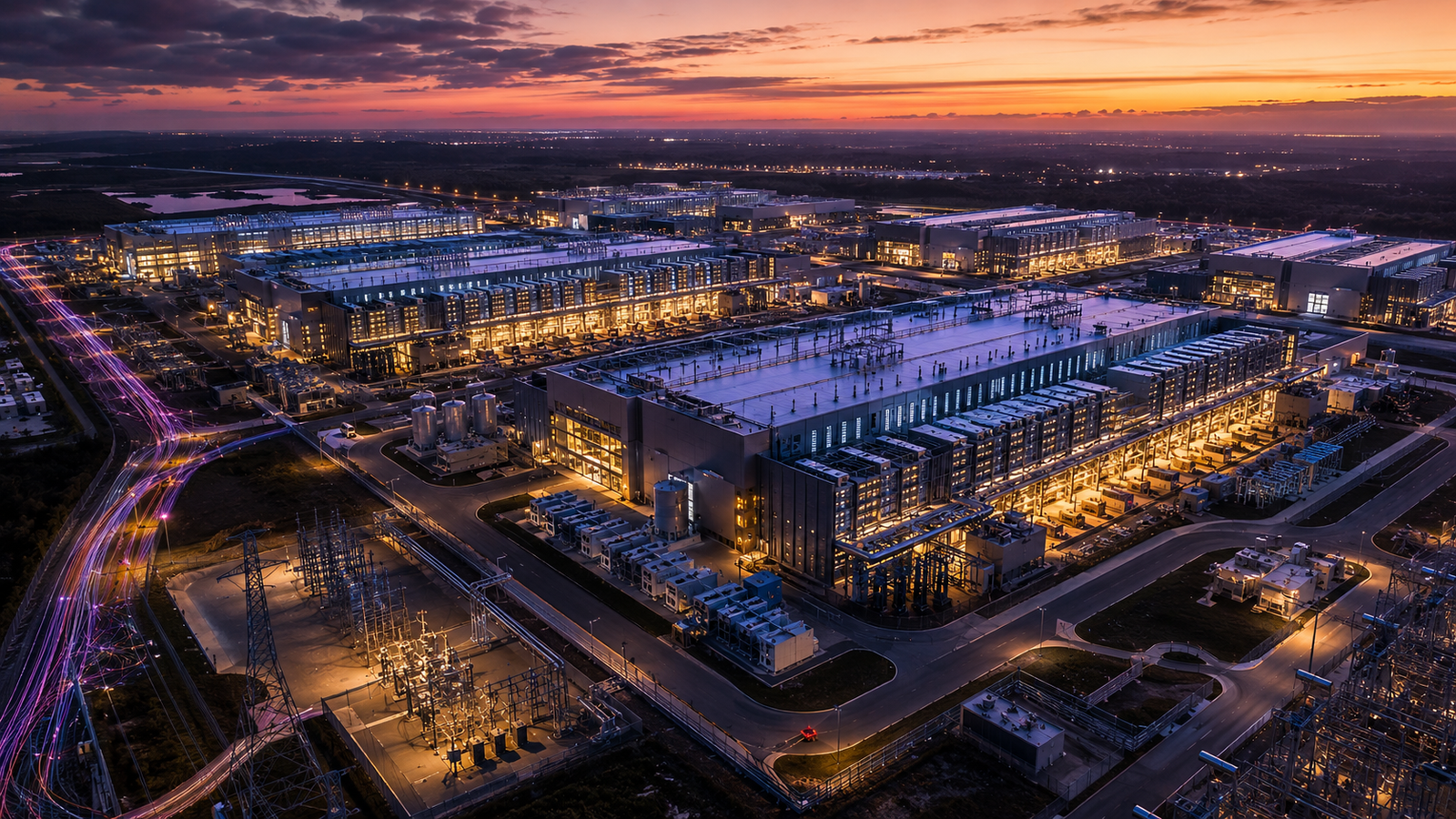
Every major technology investment cycle in history has produced two things. First, a hype cycle in which the technology’s near-term impact is overstated and capital allocators who treat projected demand as guaranteed demand make decisions they later regret. Second, physical infrastructure whose economic life extends far beyond the hype cycle and whose utilisation eventually justifies the original investment, even when the first wave of intended demand did not materialise on schedule.

The 1990s telecom buildout produced both simultaneously. The fiber optic cable laid at massive overcapacity during the dot-com boom is still carrying internet traffic today, at utilisation levels that make the original investment look prescient. The companies that financed it went bankrupt. The fiber survived. The AI infrastructure boom is following the same structural pattern, and understanding what that means requires separating two questions that the market consistently conflates.
The first question is whether AI model development and enterprise AI adoption will proceed at the pace and scale that hyperscaler capital commitments assume. That question has a genuinely uncertain answer. Nobody knows. The second question is whether the physical infrastructure being built for AI has durable economic value independent of the specific AI applications that motivated its construction. That question has a clearer answer. The answer is yes.
Physical Infrastructure Has a Different Risk Profile From the Technology It Serves
The risk profile of a data center is fundamentally different from the risk profile of an AI model. An AI model can become obsolete within months when competitors introduce superior alternatives. A data center campus with a 30-year economic life, multiple power connections, extensive fiber, and liquid cooling infrastructure for high-density compute does not lose relevance simply because the market produces a better model. It becomes more valuable, because better models require more compute to train and serve.

KKR’s analysis of AI infrastructure found that the same compounding dynamic applies here as in previous technology cycles. Every new application created demand for more bandwidth in the telecom era, and more bandwidth made more new applications possible. The firm expects the same pattern to apply to AI data centers. The infrastructure operators are deploying today will serve the first generation of commercial AI applications and the second and third generations that follow, which will be larger and more demanding than the applications that justified the original investment.
The question is not whether the infrastructure will be used. The question is whether it will be used by the specific applications that were projected when the capital was committed. That is a much more forgiving question for long-lived physical assets than it is for equity investors in specific AI companies.
The Telecom Parallel and Its Most Important Lesson
The telecom buildout comparison carries a lesson that the AI infrastructure market is not drawing carefully enough. The fiber that survived the telecom bust was not the result of undercapitalised carriers laying speculative routes with fragile balance sheets. It came from operators that built the routes that would matter regardless of which specific internet applications ultimately drove demand. Routes between major metropolitan areas, between population centres and internet exchange points, between domestic networks and international submarine cable landing stations.
The analogous distinction in AI infrastructure is between operators developing data centers in markets with durable power access, strong connectivity, and proximity to enterprise demand centres, and operators expanding into speculative markets under the assumption that demand growth would eventually justify the capacity. The AI infrastructure boom is building both. The former will have tenants regardless of which specific AI applications drive demand over the next decade. The latter will face the same reckoning that marginal fiber routes faced when the dot-com hype cycle ended. Location quality, not AI model performance, will determine which facilities survive a correction.
The Capex Commitment That Cannot Be Undone
The physical permanence of the AI infrastructure boom is reinforced by the scale of committed capital. Dell’Oro Group projects worldwide data center capex at $1.7 trillion by 2030. The top four US hyperscalers entered 2026 with combined capex approaching $600 billion. These commitments are not financial instruments that can be unwound if AI model hype disappoints. They are power purchase agreements with 15-year terms, construction contracts for facilities taking 18 to 36 months to complete, and utility partnerships reshaping national electricity generation planning for a generation.
The AI infrastructure boom has created physical and contractual commitments whose consequences extend far beyond any plausible hype cycle correction. That permanence is the investment case for AI infrastructure as a distinct asset class. Institutional investors whose capital operates on 20 to 30-year horizons are allocating to data center assets alongside airports, toll roads, and electricity transmission networks. Those investors are not making a bet on which AI model wins the next benchmark. They are making a bet that the physical infrastructure required to deploy AI at commercial scale will generate contracted cash flows for the economic life of the assets, regardless of which specific applications produce those cash flows.
Why the Recurring Capex Cycle Changes the Calculus
One dimension of the AI infrastructure boom that makes the telecom comparison imperfect is the recurring nature of the capital expenditure. Fiber optic cable, once installed, requires minimal reinvestment to continue carrying traffic. The same route built in 1999 is still functional today. Data center infrastructure serving AI workloads requires continuous capital reinvestment in GPU hardware that turns over every 18 to 24 months, cooling systems that operators upgrade to support rising rack densities, and power distribution infrastructure that operators expand as capacity grows.
This recurring capital requirement changes the investment thesis in two ways. It means the infrastructure owner has ongoing capital obligations that a fiber route owner does not have. But it also means the infrastructure owner has ongoing opportunities to upgrade the revenue-generating capacity of the asset, keeping it competitive against new facilities that would otherwise make it obsolete. Operators that deploy Blackwell hardware in a data center in 2025 can later upgrade that facility to support Rubin hardware in 2027, extending its economic relevance without replacing the underlying infrastructure. Technology upgradeability allows operators to preserve the physical building’s 30-year economic life. That is a feature of data center infrastructure that most other infrastructure asset classes do not share.
The Enterprise Adoption Timeline That Does Not Change the Long-Term Case
The most common objection to the AI infrastructure boom’s durability argument is the enterprise adoption timeline risk. If enterprises take five years instead of two to move AI workloads from pilot to production at scale, the infrastructure built against a two-year assumption will look over-built in the interim. That objection is valid for the financial structures underwriting specific investments. It is not valid for the infrastructure itself.
The difference between a data center operating at 40% utilisation and one operating at 80% utilisation is a difference in the revenue it generates, not in the physical asset’s long-term utility. The fiber routes that survived the telecom bust did not reach full utilisation in 2002 or 2003. Operators ran them at 10 to 20% of eventual capacity because the applications that would later fill them did not yet exist. YouTube did not exist until 2005. Netflix did not launch streaming until 2007. Infrastructure operators had already laid the infrastructure that now carries those services before anyone conceived those applications.
The market still does not know all of the AI applications that will eventually saturate the data center infrastructure operators are building in 2025 and 2026. Agentic AI workloads, multimodal training, real-time inference for physical AI systems, and sovereign AI programmes that governments are developing after concluding that AI compute is a strategic national asset are all demand categories that will grow into today’s infrastructure. Not on the timeline the most optimistic projections assumed. But on a timeline that will look entirely different from the current vantage point of a market evaluating infrastructure with a 20-year operating horizon against demand that has existed for only two years.
Separating Infrastructure Value From Hype-Cycle Risk
The AI hype cycle will produce its casualties. The AI infrastructure boom, built on physical assets with 30-year lives and contracted revenue from creditworthy counterparties, is a different investment from the one the hype cycle threatens. Separating those two investments is the most important analytical task the market is currently underperforming. The operators and investors who make that separation clearly will build positions that compound in value through the hype cycle correction, because the physical infrastructure they hold will continue serving demand long after the hype settles and genuine adoption arrives.
.











