The Month That Rewrote the Cooling Industry
March 2026 will be studied in business school case rooms for the specific lesson it delivered about how an industrial market transforms when the technology layer above it undergoes a step-change in physical requirements. Within a single calendar month, two transactions closed or were announced that together committed over fourteen billion dollars to a corner of the infrastructure industry that, five years earlier, would have struggled to attract a fraction of that attention from the investment community. Eaton, a company whose identity was built on power management and electrical components, completed a nine-and-a-half-billion-dollar acquisition of Boyd Thermal on March 12, specifically to acquire the liquid cooling expertise it lacked and that its data centre customers were now demanding at scale. Eight days later, Ecolab, a company whose prior identity rested on water treatment, hygiene services, and infection prevention for industrial clients, announced a four-point-seven-five-billion-dollar agreement to acquire CoolIT Systems, a Calgary-based liquid cooling specialist that KKR had held since its growth phase.
Neither of these companies was a data centre infrastructure specialist when 2025 began. Neither had liquid cooling as a core business line. Both arrived at the same strategic conclusion independently and announced their moves within eight days of each other, which tells the market something important about the nature of the demand signal both companies were responding to. When two well-capitalised industrial conglomerates with different product portfolios, different customer bases, and different strategic histories make structurally identical moves in the same month, the signal is not a coincidence in deal timing. It is evidence that the underlying market requirement had crossed a threshold at which the largest potential buyers of a scarce capability all decided, within approximately the same window of time, that they could no longer afford to access it only through vendor relationships and needed to own it outright.
The demand signal those companies were responding to is the AI infrastructure buildout, and specifically the thermal management problem that the buildout has placed at the centre of data centre design in a way that has no precedent in previous compute cycles. Hyperscale data centres being designed for commissioning from 2026 onward are specifying liquid cooling by default, not as an option for high-density workloads but as the baseline design assumption for the facilities as a whole. The rack power densities that AI training clusters now operate at, in the range of one hundred and twenty to one hundred and fifty kilowatts for demanding current-generation workloads, and the direction of travel toward even higher densities as successive GPU generations arrive, have made the thermal problem the primary constraint around which the rest of the facility design must be organised. The companies that can solve that thermal problem, at scale, with integrated hardware and chemistry and services, under a single contractual relationship that hyperscalers do not have to manage across multiple suppliers, have become extraordinarily valuable. The acquisition wave is the market’s mechanism for determining who those companies will be.
What Eaton Was Actually Buying
Grid to Chip as an Integration Thesis
Eaton’s framing of the Boyd Thermal acquisition in its public communications was direct about the strategic logic in a way that industrial acquisitions often are not. The company described the combined entity as capable of delivering integrated solutions from grid to chip, a phrase that captures, with unusual precision, what the acquisition was actually intended to create. Eaton’s existing business covered the grid end of that formulation: power management equipment, switchgear, uninterruptible power supply systems, and the electrical distribution infrastructure that moves power from a utility connection into a data centre and distributes it to individual server racks. Boyd Thermal covered the chip end: the thermal components, cold plates, heat exchangers, and liquid cooling systems that manage the heat generated once that power is consumed by the processors inside those racks.
The gap in Eaton’s portfolio, before the acquisition, was the final step in the thermal chain. Power management and thermal management were two separate vendor relationships for a hyperscaler procuring data centre infrastructure, two separate contracts, two separate implementation teams, two separate service organisations, and two separate accountability structures for any performance problem that emerged at the interface between them. When a facility’s thermal management failed to keep a GPU cluster within operating temperature, determining whether the root cause was a power distribution issue, a cooling system design issue, or an integration problem between the two required coordination between vendors who had no contractual obligation to resolve each other’s problems efficiently.
Boyd Thermal brought capabilities that traced back to aerospace thermal engineering, a domain where the requirement to manage extreme heat in constrained spaces under reliability conditions far more demanding than commercial data centres has been a design challenge since jet propulsion. The company’s origins in industrial fabrication from 1928 and its subsequent development of deep expertise in thermal management across aerospace and data centre markets gave it exactly the engineering pedigree that Eaton needed: not simply a cooling hardware manufacturer, but an organisation with the engineering depth to design thermal solutions for the most demanding computing environments rather than simply produce components to specification. Eaton integrated Boyd Thermal into its Electrical Global business segment, creating a unified division capable of delivering everything from high-voltage switchgear to the micro-manifolds that deliver coolant directly to a GPU’s surface within a single organisational and contractual framework.
The regulatory backdrop gave the acquisition additional commercial logic beyond the pure integration thesis. Power Usage Effectiveness standards, with stricter requirements approaching from 2027, are placing data centre operators under pressure to reduce their energy footprint at exactly the moment when AI workloads are driving that footprint upward. Liquid cooling’s efficiency advantage over air cooling, often enabling power usage effectiveness ratios approaching 1.1 compared to 1.4 or higher in legacy air-cooled facilities, means that the thermal management choice is no longer simply a question of whether computing equipment stays within its operating temperature range. It is also a question of regulatory compliance, green financing eligibility, and the sustainability credentials that enterprise customers and institutional investors are increasingly demanding from their data centre providers. An integrated grid-to-chip vendor that can demonstrate measurable power usage effectiveness improvement while maintaining reliability under AI workloads occupies a commercial position that neither a power management vendor nor a cooling hardware vendor could claim independently.
What Ecolab Understood That the Market Missed
The Chemistry Layer Beneath the Hardware
The reaction to Ecolab’s acquisition of CoolIT Systems in financial media initially focused on the valuation multiple as the most striking feature of the transaction, and the multiple is genuinely striking. Twenty-nine times forward EBITDA in cash for a private company is not the pricing that characterises a mature industrial sector transaction. It is the pricing that characterises a category on the cusp of structural transformation, where the buyer believes that the window to acquire a leadership position at a reasonable cost is narrow, and that waiting for the business to scale further will only make it more expensive while leaving the strategic gap unaddressed for longer.
What received less analytical attention, but is in many ways the more interesting dimension of the deal, is why Ecolab specifically was the buyer. The market’s initial question when the announcement landed was what a water treatment and hygiene services company was doing acquiring a data centre cooling specialist. The more illuminating question, the one that Ecolab’s CEO Christophe Beck answered in the deal announcement with unusual directness, is what Ecolab brings to CoolIT that a conventional technology infrastructure acquirer would not. Ecolab’s existing business reaches across more than a thousand data centres with its water treatment and chemistry services, managing the coolant chemistry, water quality, and fluid management systems that conventional data centre cooling infrastructure requires and that, in a market transitioning to liquid cooling at scale, become even more critical to maintaining performance and reliability.
The strategic combination that Ecolab’s acquisition creates is one that the market had not fully priced before the announcement: a company that can sell a hyperscaler not just the coolant distribution units and cold plates that CoolIT manufactures, but the ongoing water chemistry management, coolant conditioning, contamination monitoring, and fluid maintenance services that liquid cooling infrastructure requires throughout its operational life. CoolIT’s hardware gets the liquid onto the chip. Ecolab’s chemistry expertise keeps that liquid performing within specification for the life of the facility. Together, they represent what Ecolab described as an end-to-end fluid management and cooling platform, a framing that positions the combined company not as a hardware vendor with a service attachment but as a managed outcome provider taking responsibility for thermal performance as an integrated deliverable.
Ecolab’s characterisation of its expanded positioning within the AI ecosystem, covering semiconductor fabs that manufacture chips, power plants that fuel the chips, and data centres that utilise the chips, is ambitious in its scope but grounded in genuine existing customer relationships. The company’s water and chemistry services already reach into facilities at each of those layers. What the CoolIT acquisition adds is the hardware capability that converts those service relationships into comprehensive thermal management contracts, giving Ecolab the ability to offer something structurally similar to what Eaton is offering through the grid-to-chip framing, but approached from the chemistry and fluid management layer rather than the power distribution layer. Both companies arrived at a version of the same integrated supplier thesis through different entry points in the value chain.
Vertiv’s Response: Buying Capability, Not Companies
A Different Approach to the Same Strategic Problem
While Eaton and Ecolab made their moves through large-scale transformative acquisitions, Vertiv, the market leader in data centre physical infrastructure and the company whose liquid cooling portfolio is arguably the most extensive in the market, has been pursuing a parallel consolidation strategy through a sequence of smaller, capability-targeted acquisitions that fill specific gaps in its thermal chain rather than making a single bet on a single business. The pattern Vertiv has followed through the first half of 2026 reveals a strategic logic distinct from its competitors but converging on the same destination: an integrated thermal chain that no single technology category can address and that requires a portfolio of capabilities spanning heat generation at the chip, distribution through the facility, and rejection from the building.
In March 2026, Vertiv announced the acquisition of ThermoKey S.p.A., an Italian manufacturer of dry coolers and microchannel-based heat-exchange technologies, completing the transaction in June 2026. ThermoKey’s portfolio addressed the heat rejection end of the thermal chain, the point at which heat captured from chips by liquid cooling must be expelled from the building through dry coolers, cooling towers, or similar infrastructure. This is a component of the chain that Vertiv’s existing product portfolio did not cover with the depth that hyperscale AI campuses, which are now specifying comprehensive heat rejection infrastructure as part of their facility design, require. Adding ThermoKey’s manufacturing capabilities in EMEA alongside its heat rejection portfolio gave Vertiv both a product gap closure and a regional manufacturing capacity that supports its European growth ambitions.
In April 2026, Vertiv followed the ThermoKey announcement with the acquisition of Strategic Thermal Labs, a specialist in cold-plate design, server-side liquid cooling, and high-density thermal validation. The STL acquisition addressed a different and arguably more technically demanding gap: the engineering capability to simulate and emulate real high-density compute conditions, optimise the interaction between the thermal chain and power infrastructure, and support customers across the design, integration, commissioning, and operational lifecycle of liquid-cooled AI clusters. As Vertiv’s chief product and technology officer Scott Armul framed it in the acquisition announcement, understanding and solving heat challenges at the chip level becomes critical to system design, performance, and reliability as power densities reach unprecedented levels. STL brought the engineering depth to do that work at the interface between the server and the cooling infrastructure, exactly where system-level integration challenges are most acute and where customers’ tolerance for coordination problems is lowest.
Vertiv’s sequential acquisition approach, capability by capability, has been funded by the company’s own financial performance, which provides context for the pace and scale of its investment. First quarter 2026 net sales grew thirty percent compared to the prior year period, driven by twenty-three percent organic growth alongside the four percent contribution from acquisitions, with the Americas region expanding forty-four percent on the strength of data centre demand. The company’s trailing twelve-month organic orders grew approximately eighty-one percent compared to the prior year period, reflecting a backlog that reached fifteen billion dollars, up over a hundred percent from the same period the prior year. A company operating with that order book growth and that backlog depth has both the financial capacity and the commercial urgency to accelerate its acquisition programme, because the customers placing those orders are specifying integrated thermal chain solutions that a piecemeal product portfolio cannot credibly deliver.
What Hyperscalers Are Actually Demanding
The Integrated Supplier Thesis Under Scrutiny
The strategic logic driving all three companies’ acquisition activity ultimately rests on a specific claim about what hyperscalers want from their infrastructure suppliers, a claim worth examining with some precision rather than accepting as given because multiple companies have made the same bet on it. The claim is that hyperscalers want a single vendor capable of delivering the full thermal stack and taking accountability for it end to end, rather than sourcing cooling hardware, coolant chemistry, heat rejection, and integration services from separate suppliers and coordinating the interfaces themselves. If that claim is accurate, the companies that are building integrated thermal chain capability through acquisitions are positioning themselves for a decisive commercial advantage. If it is not, or if hyperscalers’ actual procurement behaviour continues to favour best-in-class point solutions over integrated stacks, the integration premium embedded in the acquisition multiples may prove difficult to realise.
The evidence from hyperscaler procurement behaviour in early 2026 is broadly supportive of the integrated supplier thesis, but with important nuance. Major cloud providers including AWS, Microsoft Azure, Google Cloud, and Meta have all publicly committed to liquid-cooled AI campus expansions across Northern Virginia, Iowa, Phoenix, and the Pacific Northwest, and their facility specifications increasingly call for comprehensive thermal chain solutions rather than component lists. Dell’Oro Group’s market analysis noted that hyperscalers anchor demand for liquid cooling and account for a substantial share of market revenue, with significant portions tied to purpose-built AI workloads in colocation facilities, suggesting that the primary demand driver is not distributed across many small customers but concentrated in a small number of large accounts with the scale and sophistication to demand integration.
The nuance is that hyperscalers at the scale of AWS, Microsoft, and Google have the engineering capability to integrate point solutions themselves, and have historically used that capability as a negotiating tool to maintain competitive tension between suppliers rather than committing to a single integrated provider. A hyperscaler that buys its coolant distribution units from CoolIT, its heat rejection from ThermoKey, and its integration services from a separate engineering firm is a hyperscaler that can play each of those suppliers against the others on price and technology roadmap. A hyperscaler that buys an end-to-end thermal management commitment from a single integrated supplier is a hyperscaler that has reduced its complexity and coordination burden at the cost of some negotiating leverage. Whether the coordination burden is large enough to justify giving up that leverage is a calculation that different hyperscalers may answer differently, and the market’s actual procurement decisions over the next several years will determine whether the integration thesis produces the commercial returns that the acquisition multiples in March 2026 assumed it would.
KKR’s Exit and What It Signals About Private Capital
Fifteen Times Return and an Entire Asset Class Repriced
KKR’s realisation on CoolIT Systems warrants examination as a separate signal from the strategic logic of Ecolab’s acquisition, because the private equity exit tells a story about what institutional capital has understood about liquid cooling as an investment category, and how that understanding has shifted over the period of KKR’s ownership. The transaction generated approximately fifteen times the original equity invested for KKR, a return that, by any measure, reflects the correct identification of a structural market shift before that shift had been priced into the public markets or had attracted the M&A attention that arrived in force in 2026.
KKR’s realisation on CoolIT and the simultaneously elevated multiples in the broader liquid cooling sector reflect a repricing of the entire asset class that has been underway since AI workloads began driving rack densities beyond the range that air cooling can address. The progression that one market analysis described as beginning with AI as a chip story, then becoming a power story, then a hyperscaler infrastructure story, before finally arriving at cooling as the next critical constraint, is a description of how capital markets sequentially identify and price each layer of the infrastructure stack that AI demand is placing pressure on. CoolIT’s fifteen times return is the financial record of KKR having identified the cooling layer before the broader market did.
The cooling category’s current positioning in M&A markets reflects that repricing. The Motley Fool’s analysis of the hyperscaler buildout described Eaton’s Boyd Thermal acquisition as part of an investment cycle in power generation and cooling that could represent a supercycle for infrastructure suppliers, a framing that captures the scale of the opportunity while raising the appropriate question about whether supercycle framing is a signal of genuine structural demand or a sign that asset prices in the category have moved ahead of the revenue reality. The fourteen-plus billion dollars committed in March 2026 alone to liquid cooling acquisitions suggests that at least two well-capitalised strategic acquirers with genuine visibility into data centre customer demand reached the conclusion that structural demand was real and that the cost of waiting exceeded the cost of paying a premium to acquire capability now.
The Integration Execution Risk Nobody Priced In
When Buying Capability and Building Capability Are Different Problems
The strategic logic of each acquisition is coherent, and the market demand driving that logic is genuine. What acquisitions consistently underdeliver on, and what the cooling consolidation wave will eventually be tested on, is the execution challenge of actually integrating acquired capability into the acquiring company’s product development, sales, and delivery operations in a way that produces the end-to-end coherence that the integration thesis promises to customers. Eaton acquiring Boyd Thermal creates the organisational preconditions for a grid-to-chip solution. It does not automatically produce a sales force capable of selling that solution coherently, engineering teams capable of designing it without the organisational friction between a legacy power management culture and a thermal engineering culture, or a project delivery organisation capable of commissioning it in a hyperscale facility on the timeline that a major construction programme requires.
Ecolab’s integration challenge is, in some respects, steeper than Eaton’s, because the distance between Ecolab’s existing operational identity as a water treatment and hygiene services company and CoolIT’s identity as a hardware engineering company is larger than the distance between Eaton’s power management identity and Boyd Thermal’s thermal engineering identity. Both Eaton and Boyd operate in the physical infrastructure of data centres. Ecolab’s core business has historically been chemistry and services for industrial and commercial clients rather than engineered hardware for hyperscale data centre operators. The cross-selling opportunity that Ecolab articulated, combining CoolIT’s hardware relationships with Ecolab’s existing presence across more than a thousand data centres through its water services business, is genuine and potentially valuable. Realising it requires the combined commercial organisation to present a coherent joint value proposition to customers who currently think of Ecolab as a services vendor and CoolIT as a hardware vendor, a translation that takes time and management attention to accomplish without losing the existing customer relationships on either side.
Vertiv’s sequential, capability-targeted acquisition strategy carries a different but related execution risk: the risk that a portfolio of acquisitions made at different times, from different sellers, covering different technical domains, never fully integrates into the coherent end-to-end thermal chain that the strategy promises. STL’s cold-plate engineering capability, ThermoKey’s heat rejection portfolio, the BMarko structural fabrication capability acquired in April 2026, and Vertiv’s existing product lines all need to work together in a facility design with a coherent reference architecture, supported by integrated engineering services, and delivered by a project organisation that treats the full thermal chain as a single system rather than a collection of separately-sourced components. The acquisitions are the inputs. The integrated system capability is the output. The gap between the two is where M&A value creation is won or lost, and it is a gap that quarterly financial results, however strong, do not directly measure.
A Market Being Built at Acquisition Speed
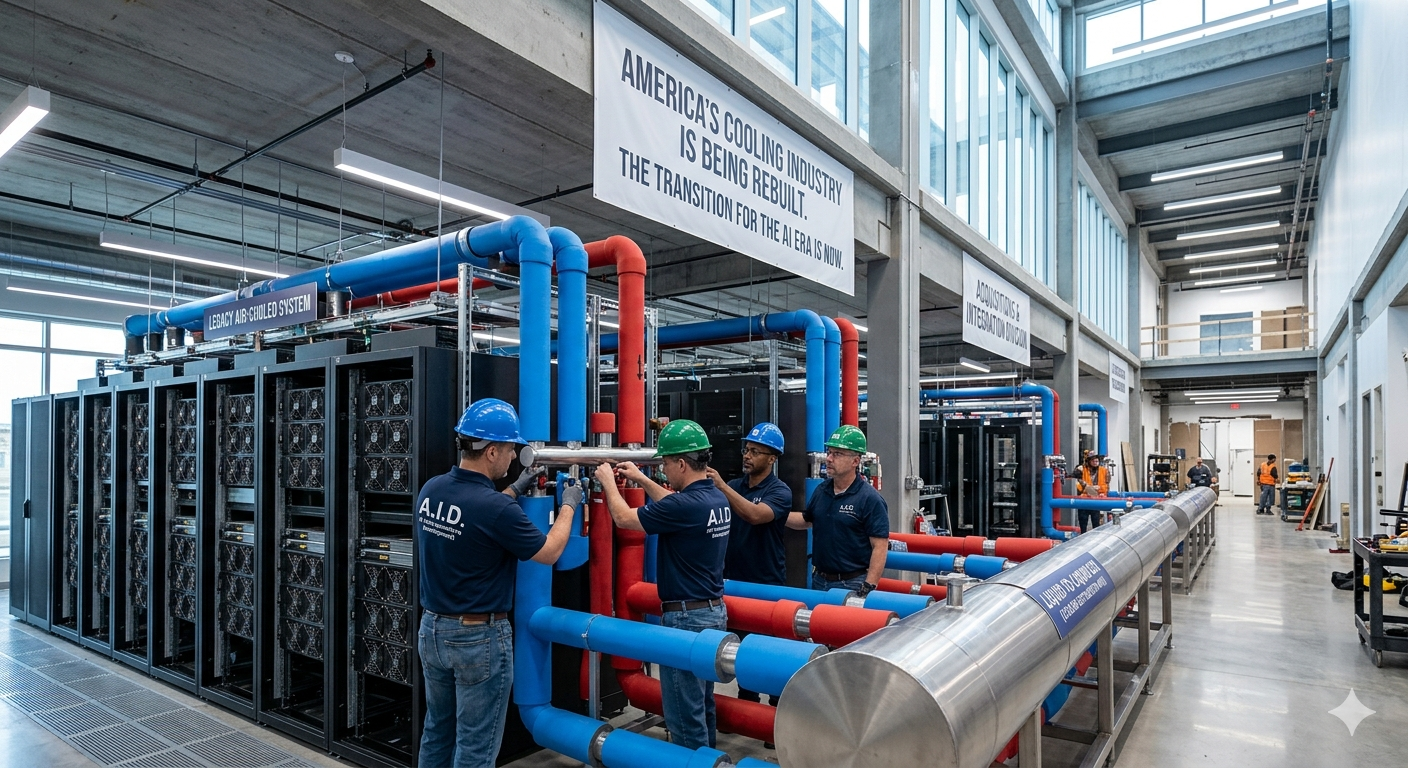
The consolidation wave reshaping America’s cooling industry in 2026 is moving faster than the technology adoption it is designed to serve, which is the correct direction for an industry that has historically lagged behind compute hardware evolution and is now attempting to ensure that thermal management capability is in place before the density problem outpaces the available solutions. Eaton’s grid-to-chip thesis, Ecolab’s fluid management platform, and Vertiv’s sequential thermal chain construction are three different expressions of the same underlying conviction: that the AI buildout has permanently changed the commercial structure of the data centre infrastructure market, and that the companies positioned as integrated thermal solution providers will capture a disproportionate share of the capital that hyperscalers, AI infrastructure operators, and colocation providers are now committed to deploying.
Whether the integration thesis produces the commercial outcomes that the acquisition multiples assumed is the question the next several years of deployment experience will answer. Fourteen-plus billion dollars was committed in a single month to liquid cooling capability. Vertiv’s backlog of fifteen billion dollars reflects the demand pipeline that justifies those commitments. The gap between deal announcement and operational integration, between strategic intent and delivered customer outcome, is the space in which the cooling consolidation wave will either be validated as the right read of a structural market transition or reveal itself as an expensive response to a demand signal that was real but whose commercial implications for integrated suppliers were less clear-cut than the acquisition logic assumed. The market has bet, emphatically and at scale, on the former.