
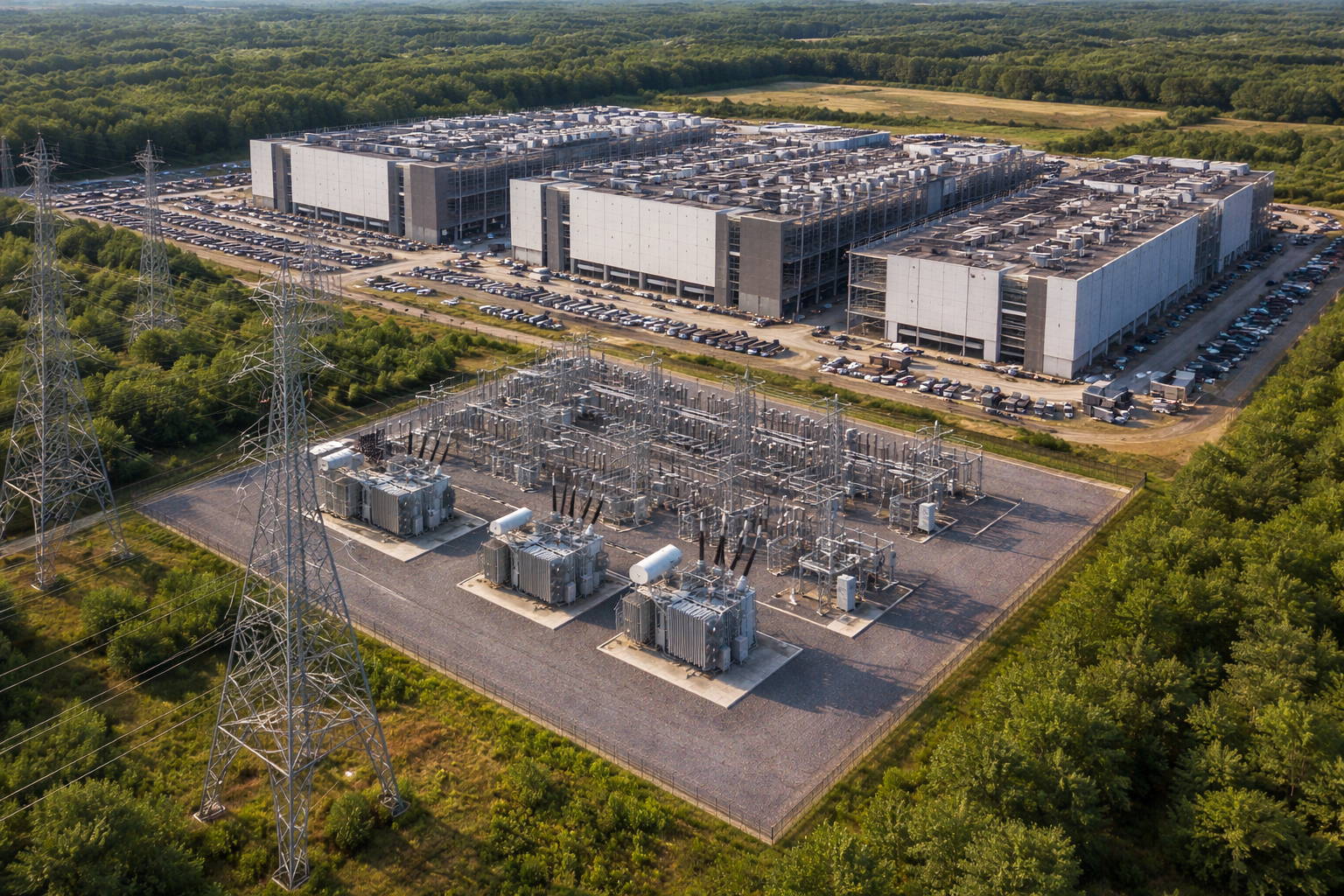
The conversation about AI infrastructure has spent considerable time focused on chips, cooling systems, and capital availability. These are real constraints, and the industry has responded to each of them with investment, engineering innovation, and new business models. What has received comparatively less attention is the constraint that sits upstream of all of them: the ability to connect a new facility to the grid at the power levels that AI workloads require. Grid interconnection, the process through which a new large load secures a formal connection agreement with a transmission or distribution utility, has become the longest lead-time item in data center development. In markets where AI infrastructure demand is most concentrated, that process now takes years rather than months, and the queue of projects waiting for connection agreements grows faster than utilities can work through it.

The implications extend beyond project timelines. When interconnection becomes the binding constraint on infrastructure development, it reshapes every other aspect of how operators plan, invest, and compete. Site selection decisions that once balanced multiple factors now weight power access above all others. Capital allocation frameworks that assumed predictable development timelines are shifting around interconnection uncertainty. The competitive dynamics of the AI infrastructure market increasingly depend not on who has the best technology or the most capital, but on who secured grid access before the queues became unmanageable. That shift is structural, and it will not resolve itself without deliberate intervention at the utility, regulatory, and policy levels.
Why the Queue Exists and Why It Keeps Growing
Grid interconnection queues exist because connecting a new large load to the transmission or distribution system requires a formal study process. Utilities must evaluate the impact of that load on grid stability, voltage profiles, and equipment capacity. They must determine whether existing infrastructure can accommodate the new load, what upgrades are necessary, and how costs for those upgrades will be split between the connecting customer and the broader rate base. This process has always taken time, but engineers designed it around a rate of new large load additions that the current AI infrastructure buildout has exceeded by a significant margin. The backlog in major transmission regions has grown to the point where new interconnection requests in some service territories carry study timelines that extend several years into the future, well beyond the development horizons that most project capital structures can accommodate.
Projects that entered the queue in anticipation of near-term development are discovering that their interconnection agreements will not arrive until well after their original operational target dates. Many developers abandon queue positions when timelines extend beyond what their financing arrangements or customer commitments can support, and those exits partially clear the backlog. However, this attrition does not solve the underlying problem. The rate of new requests continues to exceed the rate at which utilities can complete the study process and issue connection agreements. The queue replenishes faster than it drains, and the average wait time for a new interconnection request in constrained markets keeps lengthening rather than stabilising.

A Problem That Predates the AI Cycle
The interconnection queue problem predates the current AI infrastructure cycle. Renewable energy developers hit the same bottleneck as solar and wind projects proliferated faster than transmission infrastructure could support them. The underlying issue is a study process that engineers designed for a slower rate of grid change, run by utilities with limited staffing and regulatory frameworks that predate the current pace of infrastructure investment. AI data center demand did not create this problem, but it has concentrated a large volume of high-power interconnection requests into specific transmission regions over a short period. That compression has turned a backlog that was already significant into something that now disrupts operations across the industry.
The power density requirements of AI infrastructure make the queue problem more acute than it was for previous generations of data center development. A hyperscale facility built for conventional cloud workloads might have required a certain level of grid connection capacity. An AI-optimised facility of comparable physical scale can require substantially more, because GPU-dense compute infrastructure draws power at intensities that conventionally loaded facilities never approached. Each AI data center interconnection request therefore consumes more queue capacity and demands more extensive grid impact studies than its predecessors, multiplying the strain on utility study processes that operators already stretched beyond their designed throughput.
Stranded Assets and Lengthening Development Cycles
The practical consequence of extended interconnection timelines is that data center development cycles have lengthened in ways that affect every downstream decision a developer makes. Construction can proceed on facilities before interconnection agreements arrive, but operators cannot commission and load AI infrastructure without confirmed power delivery. Projects that reach mechanical completion before their interconnection studies resolve sit as stranded assets, with capital deployed and no revenue flowing while utility processes work through their backlogs. Developers now price the carrying cost of that stranded period into project economics from the outset, adding a layer of cost and uncertainty that did not exist in previous infrastructure cycles.
Customer commitments are also shifting. Hyperscalers and AI operators signing capacity agreements with data center developers are encountering longer lead times than previous infrastructure cycles required. Interconnection uncertainty makes it harder for developers to commit to delivery dates with confidence. Some customers respond by diversifying their supply relationships across more developers and more markets, attempting to reduce their exposure to any single interconnection risk. Others accelerate their own land and power acquisition activities, following the logic that controlling grid access directly is more reliable than depending on third-party developers to deliver it within promised timeframes. Crusoe‘s behind-the-meter model in Abilene, Texas and Tract Capital‘s approach to securing powered land ahead of demand both reflect how seriously the market now treats this dynamic.
Regulatory Frameworks Have Not Kept Pace
Utility interconnection processes operate under regulatory frameworks that engineers and policymakers designed around a different infrastructure environment. Reform efforts at the federal level have produced incremental improvements but have not resolved the fundamental mismatch between the volume of interconnection requests the current infrastructure cycle generates and the capacity of the study process to handle them. State-level utility regulation adds further complexity, as distribution-level interconnections fall under state public utility commissions with varying rules, staffing levels, and processing speeds. Operators who understand those variations hold a material advantage in site selection over those who treat interconnection as a uniform process across markets.
The policy conversation around data center energy use has focused primarily on consumption, with proposals ranging from mandatory reporting requirements to construction moratoria. These concerns are legitimate, but the policy responses under discussion address symptoms rather than the structural cause. Mandatory reporting of energy consumption does not shorten interconnection queues. The policy interventions most likely to materially improve the infrastructure development environment are those that target the interconnection process directly, including additional funding for utility study capacity, regulatory reforms that cut the time required to complete grid impact assessments, and transmission investment frameworks that anticipate AI-driven load growth rather than reacting after congestion materialises.
Queue Position Is Now a Competitive Asset
The operators best positioned in the current environment are those who recognised early that interconnection queue position was a strategic asset worth investing in. Securing interconnection requests in multiple markets, building relationships with utility planning teams, and participating in transmission planning processes gave early movers a queue position advantage that now translates into real competitive differentiation. Developers entering the market today must prioritise understanding interconnection timelines at a granular level before committing capital to site development.
The AI infrastructure market will continue to grow, and grid capacity will expand over time as transmission investment catches up with demand. The developers who manage interconnection risk most effectively during the current constrained period will be best positioned to capitalise on that expansion when it arrives. Grid access has moved from a background operational requirement to a front-line strategic priority, and the companies that treat it accordingly are already shaping the competitive geography of AI infrastructure for years to come.











