
NVIDIA H200 shipments delayed to Q3  · BREAKING: Microsoft confirms 3GW data centre expansion in Asia-Pacific ·  AWS announces new sovereign cloud regions in India and UAE  · Arm-based servers now 24% of hyperscale deployments ·  EU AI Act enforcement enters phase two  · Global data centre investment hits $612B in 2026 ·  TSMC Arizona yields improve to 68% on 3nm process  · OpenAI valuation reaches $400B after latest funding round ·  NVIDIA H200 shipments delayed to Q3  · BREAKING: Microsoft confirms 3GW data centre expansion in Asia-Pacific ·  AWS announces new sovereign cloud regions in India and UAE  · Arm-based servers now 24% of hyperscale deployments ·  EU AI Act enforcement enters phase two  · Global data centre investment hits $612B in 2026

They Say Air Cooling Is Dead. Is It, Really?

For the past three years, this conversation has sounded like an obituary. As the generative AI boom pushed demand for

Share
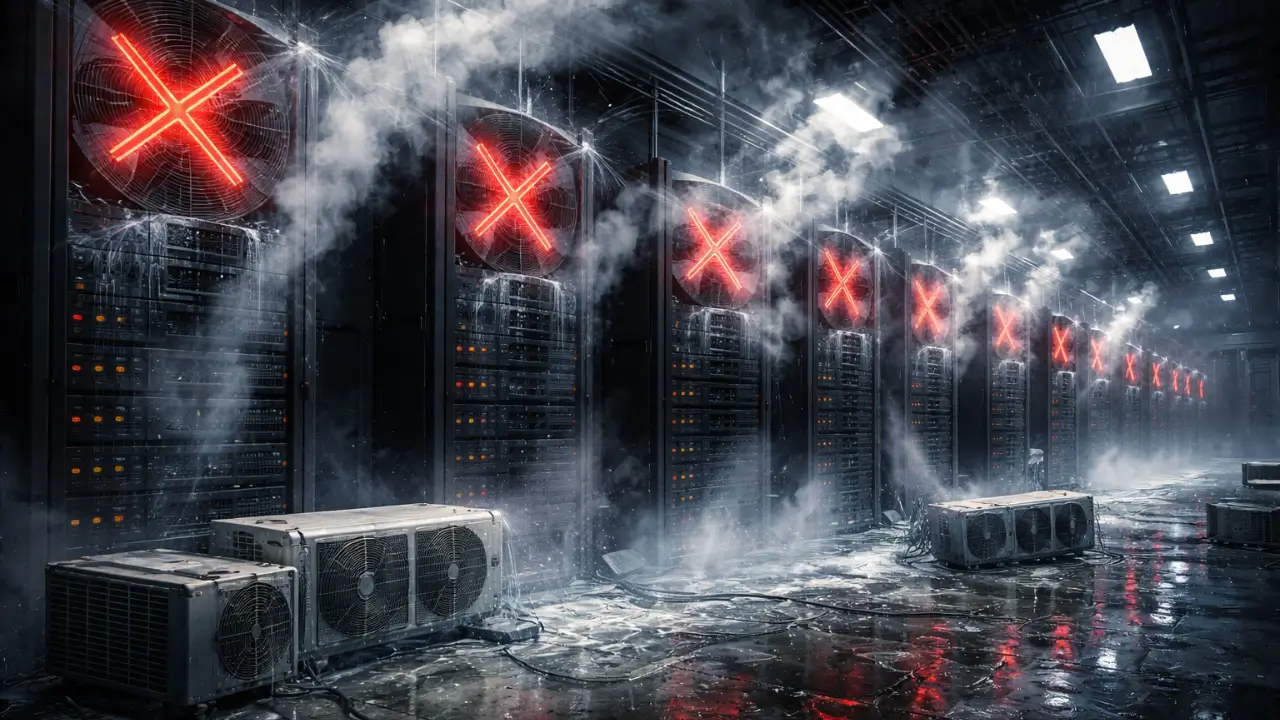
Air cooling for AI data centers

For the past three years, this conversation has sounded like an obituary. As the generative AI boom pushed demand for high-performance GPUs such as NVIDIA’s H100 and B200 to unprecedented levels, a new consensus took hold. Air cooling, the industry was told, had reached the end of the road.

At first glance, the logic appeared unassailable. The industry was moving from 30 kilowatt racks to configurations exceeding 100 kilowatts. Trying to cool those systems with chilled air increasingly felt impractical, akin to cooling a blast furnace with a desk fan. Liquid cooling, whether direct-to-chip or full immersion, came to be framed as the only viable future.

Yet something unexpected happened along the way. Air cooling did not vanish. Instead, it adapted. As the industry now approaches what many call the Blackwell era, attention has shifted. The discussion now centers on how air cooling has remained relevant during the most thermally demanding period in computing history.

The Thermodynamics Behind the Panic

To understand why air cooling was written off so confidently, it helps to revisit the physics of the modern chip. During the era of traditional cloud computing, a typical server rack consumed between 10 and 15 kilowatts. That load could be managed with raised floors, perforated tiles, and large CRAH units circulating chilled air through the room.

Then AI arrived, and with it came what many operators now describe as a heat storm.

A single NVIDIA H200 GPU carries a thermal design power of up to 700 watts. Populate a server with eight of them, stack multiple servers into a rack, and the resulting power density fundamentally alters the cooling equation. Air, with its low heat capacity, struggles to remove heat fast enough when components are packed this tightly. At extreme densities, it begins behaving less like an effective coolant and more like a thermal bottleneck.

As rack densities climb toward 120 kilowatts, another constraint emerges. The fans, ducting, and airflow pathways required to move sufficient volumes of air begin to occupy more physical space than the compute hardware itself. This so-called density wall is what convinced many engineers that air cooling had reached a hard limit.

Why the Obituary Was Premature

If liquid cooling is vastly more efficient at transporting heat, roughly three thousand times more effective than air by some measures, it raises an obvious question. Why are the world’s largest colocation providers still commissioning air-cooled halls?

The answer lies less in thermodynamics and more in economics, risk, and operational reality.

First, there is the brownfield problem. Most of the world’s data center capacity already exists, and it was designed around air cooling. Retrofitting these facilities for liquid cooling requires substantial capital investment. New piping, pumps, coolant distribution units, and reinforced floors are often necessary to support liquid-filled racks. For many operators, practical constraints shape decision-making as much as technical ideals.

Second, liquid cooling introduces a new layer of operational risk. Even with modern quick-connect fittings and advanced leak-detection systems, circulating liquid near multi-million-dollar GPU clusters carries consequences that facility teams must weigh carefully. A single failure involving water or dielectric fluid can lead to severe equipment damage. By contrast, air cooling remains familiar, predictable, and dry, qualities that still carry operational weight.

Finally, air cooling itself has undergone significant refinement. Engineers pushed airflow optimization far beyond what was considered practical a decade ago. Rear-door heat exchangers now act as localized radiators, stripping heat from exhaust air before it enters the room. AI servers rely on counter-rotating fans operating at extreme speeds, trading acoustics for thermal headroom. Containment strategies have evolved from basic hot and cold aisle separation to near-total physical isolation, ensuring that cooled air is used with far greater precision.

Taken together, these advances extended the relevance of air cooling well beyond earlier expectations.

The Hybrid Middle Ground

As the debate matured, the framing of cooling as a binary choice began to break down. In practice, the industry is converging on hybrid designs.

In a hybrid data center, air cooling manages the base load. Networking equipment, storage arrays, and lower-TDP CPUs continue to rely on airflow. At the same time, liquid cooling is applied directly at the hottest points in the rack, typically through direct-to-chip cold plates attached to GPUs. Many deployments now feature racks that rely predominantly on liquid while still retaining a role for air.

This approach preserves much of the operational familiarity of traditional facilities. Operators do not need to convert their data halls into specialized wet environments. Instead, they integrate coolant distribution units alongside conventional air handlers. As a result, hybrid cooling has emerged as a pragmatic bridge between legacy designs and fully liquid-cooled architectures.

Blackwell as the Stress Test

If air cooling faces a defining stress test, it is NVIDIA’s Blackwell platform. The GB200 NVL72 rack operates at roughly 120 kilowatts, a level at which airflow struggles on efficiency grounds alone. At those densities, the fans required to keep components within thermal limits can consume 10 to 15 percent of the rack’s total power budget.

That overhead becomes increasingly difficult to justify, particularly at scale.

Even at this threshold, air cooling continues to occupy a narrower but persistent niche. Many organizations are not training frontier-scale models. Smaller AI clusters, inference workloads, and fine-tuning tasks built around 70-billion-parameter models still fall within ranges where air-cooled or hybrid configurations remain economically viable. For this mid-market segment, air cooling continues to offer a balance of cost, familiarity, and deployability.

The Sustainability Trade-Off

Cooling strategies are also shaped by sustainability metrics, particularly PUE. Air cooling typically requires more electrical power to operate fans and chillers. Liquid systems, by contrast, can often rely on dry coolers that dissipate heat using ambient air, reducing dependence on energy-intensive refrigeration.

However, efficiency gains on the electrical side often come with increased water consumption. Many liquid cooling deployments still depend on evaporative cooling towers, which can consume millions of gallons of water annually. In water-stressed regions such as Arizona or parts of India, both major growth markets for data centers, this trade-off carries real significance.

In those contexts, air cooling, which operates as a closed-loop system with minimal water use, is frequently viewed as the more responsible option, even when electrical efficiency metrics appear less favorable.

So, Where Does Air Cooling Stand?

Air cooling has shifted roles within the data center landscape.

What once served as the universal default now functions as a targeted solution, applied where its strengths align with operational and economic realities. Over the next five years, a clear bifurcation is likely to emerge. Hyperscale AI facilities training the largest foundation models will move decisively toward liquid and immersion cooling. At the same time, enterprise data centers, edge deployments, and regional hubs will continue to rely on air, supported by hybrid enhancements.

Declaring air cooling obsolete overlooks the engineering ingenuity that has sustained it under extraordinary pressure. Cooling 40 kilowatt racks using carefully managed airflow remains a nontrivial technical achievement.

Air cooling has reached clearer boundaries, and that clarity matters. In infrastructure, understanding where a technology performs best often provides the foundation for building what comes next.


[simple-author-box]

More from AI Infrastructure

The race to build AI infrastructure is exposing a challenge that extends far beyond

Electricity prices have long shaped conversations about infrastructure investment, yet they rarely remain the

Artificial intelligence has shifted the economics of digital infrastructure beyond processors and server clusters,

COMPUTE WEEKLY

The briefing that 40,000+ tech leaders read every Monday. Sharp, fast, essential.

Great! We’ve received your information.

We couldn’t process your submission. Please retry

Building an AI Startup Without Owning GPUs

Not owning GPUs has become the default, deliberate strategy for building an AI company — not a compromise founders accept reluctantly. H100 rental rates fell 64-75% in fifteen months, a dense ecosystem of neoclouds and inference-as-a-service providers now lets startups skip infrastructure entirely, and credit programs can fund a company’s first year before a founder writes a check
Most Read

Infrastructure planning discussions often prioritize engineering, construction, and utility considerations before examining how end

AI infrastructure deployment schedules depend on coordinated progress across hardware availability, electrical infrastructure, cooling

Artificial intelligence has transformed the economics of digital infrastructure. Every new AI model requires

Data centers do not visibly smoke. They have no smokestacks, no visible exhaust, and

Artificial intelligence has transformed the economics of digital infrastructure. Companies once competed by acquiring

Disruptor Spotlight

Cerebras Systems

The chip that makes Nvidia nervous. Cerebras’ Wafer Scale Engine is rewriting the rules of AI inference at scale.
Faster
0 x
YoY Revenue
0 x
Transistors
0 T
Market Pulse
NVDA
$924.60
-2.11%
MSFT
$421.30
-2.94%
AMZN
$192.80
-4.87%
AMD
$924.60
-2.40%
TSMC
$924.60
-2.32%
Indicative only · Not financial advice
Upcoming Events
SEP
The AI Infrastructure Race (India)
WEBINAR · ONLINE
The AI Infrastructure Race: Won on Power, Land and Trust — Not Capital
MAY
0
AI Infrastructure Summit
DUBAI · IN PERSON
MEA’s premier AI infrastructure event.
JUN
0 0
Compute Forecast Summit
SINGAPORE · IN PERSON
Our flagship APAC event. Early bird open.
Latest Moves
Live
ecolab
Ecolab Deepens Cooling Strategy With $4.75B CoolIT Acquisition
Ecolab is making one of its biggest moves yet into AI infrastructure after completing its $4.75 billion acquisition of liquid cooling specialist CoolIT Systems
Pure DC AVK Europe data center microgrid Dublin 110MW AI infrastructure Ireland 2026
Pure DC and AVK Deploy Europe’s First 110 MW Data Center Microgrid in Dublin
The Pure DC Dublin microgrid has made history as Europe’s first large-scale on-site data center microgrid, launched in partnership with power solutions provider AVK at Pure DC’s campus in Ireland.
Pace Digitek
Pace Digitek Partners With MEGMEET to Expand AI Data Center Power Business
India’s AI infrastructure ecosystem continues to mature as domestic technology manufacturers move beyond traditional telecommunications and industrial markets toward high-growth digital infrastructure opportunities
Follow Compute Forecast
11K followers
1200 followers
Companies to Watch
CW
CoreWeave
Neo Cloud · $19B · IPO Watch
CB
Cerebras Systems
AI Hardware · $4.25B · Pre-IPO
G42
G42
Sovereign AI · Abu Dhabi
H
Humain
Saudi AI · $40B Fund
Latest Podcast
AI Capex, Cloud Margins & the Nuclear Bet
48 MIN · 25 APR 2026

They Say Air Cooling Is Dead. Is It, Really?

For the past three years, this conversation has sounded like an obituary. As the generative AI boom pushed demand for

Share
Air cooling for AI data centers
18
847 SHARES

0
SHARES

[simple-author-box]

More from AI Infrastructure

Infrastructure planning discussions often prioritize engineering, construction, and utility considerations before examining how end

AI infrastructure deployment schedules depend on coordinated progress across hardware availability, electrical infrastructure, cooling

Artificial intelligence has transformed the economics of digital infrastructure. Every new AI model requires

Data centers do not visibly smoke. They have no smokestacks, no visible exhaust, and

COMPUTE WEEKLY

The briefing that 40,000+ tech leaders read every Monday. Sharp, fast, essential.

Great! We’ve received your information.

We couldn’t process your submission. Please retry

Global AI Infrastructure Outlook 2026

The briefing that 40,000+ tech leaders read every Monday. Sharp, fast, essential.
Download Free
Most Read

Infrastructure planning discussions often prioritize engineering, construction, and utility considerations before examining how end

AI infrastructure deployment schedules depend on coordinated progress across hardware availability, electrical infrastructure, cooling

Artificial intelligence has transformed the economics of digital infrastructure. Every new AI model requires

Data centers do not visibly smoke. They have no smokestacks, no visible exhaust, and

Artificial intelligence has transformed the economics of digital infrastructure. Companies once competed by acquiring

Disruptor Spotlight

Cerebras Systems

The chip that makes Nvidia nervous. Cerebras’ Wafer Scale Engine is rewriting the rules of AI inference at scale.
Faster
0 x
YoY Revenue
0 x
Transistors
0 T
Market Pulse
NVDA
$924.60
+2.4%
MSFT
$421.30
+1.1%
AMZN
$192.80
-0.6%
NVDA
$924.60
+2.4%
NVDA
$924.60
+2.4%
Indicative only · Not financial advice
Upcoming Events
MAY
0 0
DCD Global — London
LONDON · IN PERSON
World’s largest DC event. CF is media partner.
MAY
0
AI Infrastructure Summit
DUBAI · IN PERSON
MEA’s premier AI infrastructure event.
JUN
0 0

Compute Forecast Summit

SINGAPORE · IN PERSON
Our flagship APAC event. Early bird open.
Latest Moves
  • Live
Sam Altman
OpenAI appoints new Chief Infrastructure Officer to lead $100B DC programme
27 APR · OPENAI
Sam Altman
OpenAI appoints new Chief Infrastructure Officer to lead $100B DC programme
27 APR · OPENAI
Sam Altman
OpenAI appoints new Chief Infrastructure Officer to lead $100B DC programme
27 APR · OPENAI
Follow Compute Forecast
18.4K followers
12.1K followers
9.3K subscribers
41 episodes
Companies to Watch
CW
CoreWeave
Neo Cloud · $19B · IPO Watch
CB
Cerebras Systems
AI Hardware · $4.25B · Pre-IPO
G42
G42
Sovereign AI · Abu Dhabi
CW
Humain
Saudi AI · $40B Fund
Latest Podcast
AI Capex, Cloud Margins & the Nuclear Bet
48 MIN · 25 APR 2026
Scroll to Top








